
Finding Residents Across Lafayette
Begin with the sharpest identifier you have. An address points first to the Lafayette Parish Assessor and its linked Beacon map. A full name fits an official index instead. Try accents, apostrophes, initials, suffixes, maiden names, and entity names as separate searches, because directories miss variants quietly. A parcel number beats a surname. So does a case number, file number, or date. Those narrow a common name far better than any broad residents directory query.
Each roll proves something different. The tax roll names an owner or entity tied to land, while a deed lists parties to a recorded transfer and a printed directory makes a dated statement about an occupant or business. The voter portal shows current public registration context but hides protected fields, so keep each record's role separate.
- Normalize the name or address, including its unit, directional, suffix, and older spelling.
- Check the Assessor or Beacon for a current parcel, owner, situs, and stable parcel number.
- Use the Louisiana voter portal or court index only for the public clue each system supplies.
- Carry the parcel, party name, or legal description into the Clerk's land index.
- Ask the library, archives, or records custodian when an index stops or a search screen fails.
Lafayette Residents Records Offices
Lafayette splits its records among several custodians. The Clerk records land transfers and keeps court and marriage indexes, while the Assessor identifies, locates, and values parcels. The Registrar of Voters answers local registration questions. The Secretary of State runs the public voter portal. Because they are separate custodians, one empty result is never a final answer.
Lafayette Parish Clerk of Court
800 S. Buchanan St.
Lafayette, LA 70501
337-291-6400
Lafayette Registrar of Voters
1010 Lafayette St., Suite 313
Lafayette, LA 70501
337-291-7140
The Clerk's land research line is 337-291-6300. Call it before hauling a camera to the courthouse. Counter, phone, and written copy requests still work well when a subscription or image barrier blocks online research, though courthouse rules restrict devices.
Lafayette Assessor Directory Search
The Lafayette Parish Assessor search hides an important split. Its visible owner-name box searches business personal property, not residential real estate. Real-estate searches beyond an assessment number move to Beacon. So a blank business-name result says nothing about whether a person owns a home.
| Visible field | Input | Use | Limit |
|---|---|---|---|
| Account Number | Text | Real estate or business assessment | Not marked required |
| Business Owner Name | Text | Business personal property | Not a residential name search |
| Search | Button | Submit query | Uses chosen field |
| GIS link | Link | Other real-estate parameters | External viewer |
The official form appears in this Lafayette property-search screen.
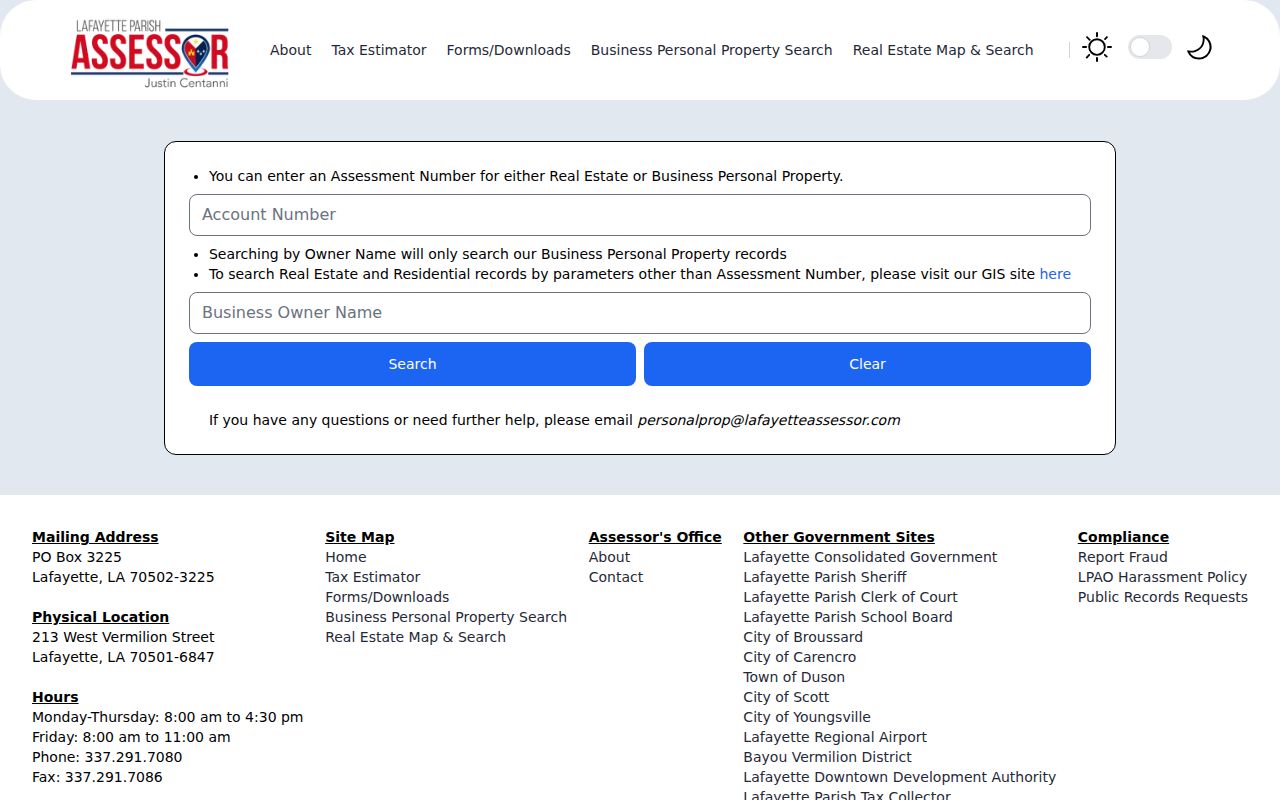
The assessment number earns its keep. It is the best stable bridge from a street address into tax-roll records, as the Assessor's search page itself makes plain.
Lafayette Land Records Directory
The Clerk's conveyance index turns a parcel owner into a dated chain of recorded parties. Search both sides of each transfer. The vendor conveys an interest; the vendee receives it. The vendor index begins January 1, 1935, while regular conveyance and vendee coverage starts January 1, 1966, and land images reach back to 1935 as well. Older work means office books or State Archives microfilm. The Lafayette land eSearch login page shows the account route and its Certified Good-Thru link.
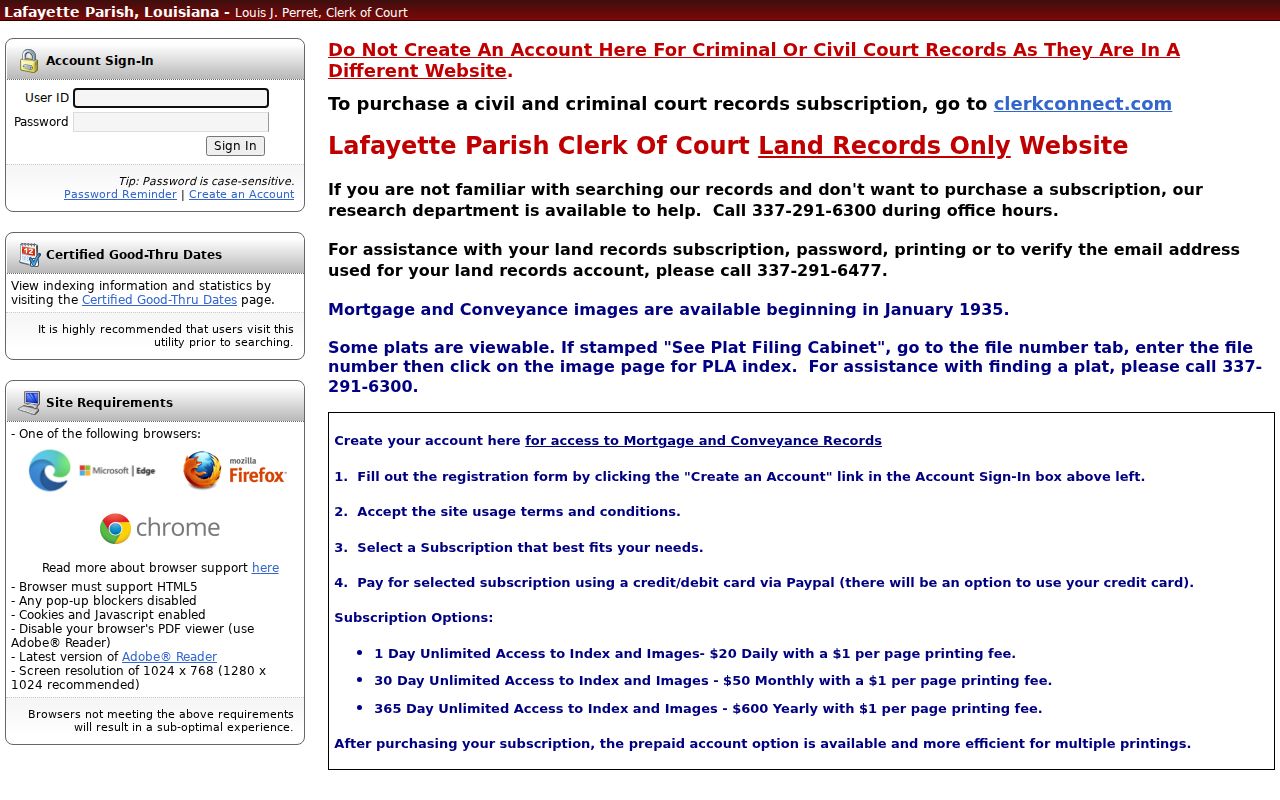
Save these details. Keep the index type, party role, file number, record date, document type, legal description, and image status, and remember that a deed party's address is not always the property's physical address.
- Parcel
- A mapped unit of land with an assessor identifier.
- Index
- A finding list that points to a record, not the complete document.
- Grantor and grantee
- Parties giving and receiving an interest, often vendor and vendee in Lafayette.
- Criss-cross directory
- A directory arranged by street or address instead of only by surname.
Current Lafayette Residents Directories
Current sources cover different slices of Lafayette. Dates and coverage matter more than match counts. Official rolls are usually free to search, though copies, subscriptions, and ordered datasets can cost money.
| Resident source | What it can establish | Custodian | Access path |
|---|---|---|---|
| Property roll | Tax owner, parcel, value, situs clues | Parish Assessor | Free form and Beacon |
| Voter lookup | Limited current registration context | Secretary of State | Free public portal |
| Land index | Parties to conveyances and mortgages | Parish Clerk | Index, account, counter |
| Court index | Named parties and docket context | Clerk or court | Parish, city, federal routes |
| Business records | Entity, officer, or agent clues | Secretary of State | Free commercial search |
Commercial finders often merge stale files without naming a custodian or record date. Official sources are narrower. They state plainly what each record is. So take the first match from an official index, inspect the underlying image when permitted, and request a certified copy when you need something authoritative.
Lafayette Voter Directory Clues
The Louisiana Voter Portal runs two ways. Name mode takes a first and last name plus ZIP code and birth month and year, while address mode asks for ZIP, address, apartment or lot, and city. Results cover registration and ballots. They prove no land ownership. The official voter lookup by name page shows its fields before a search, and it never lists every household member.
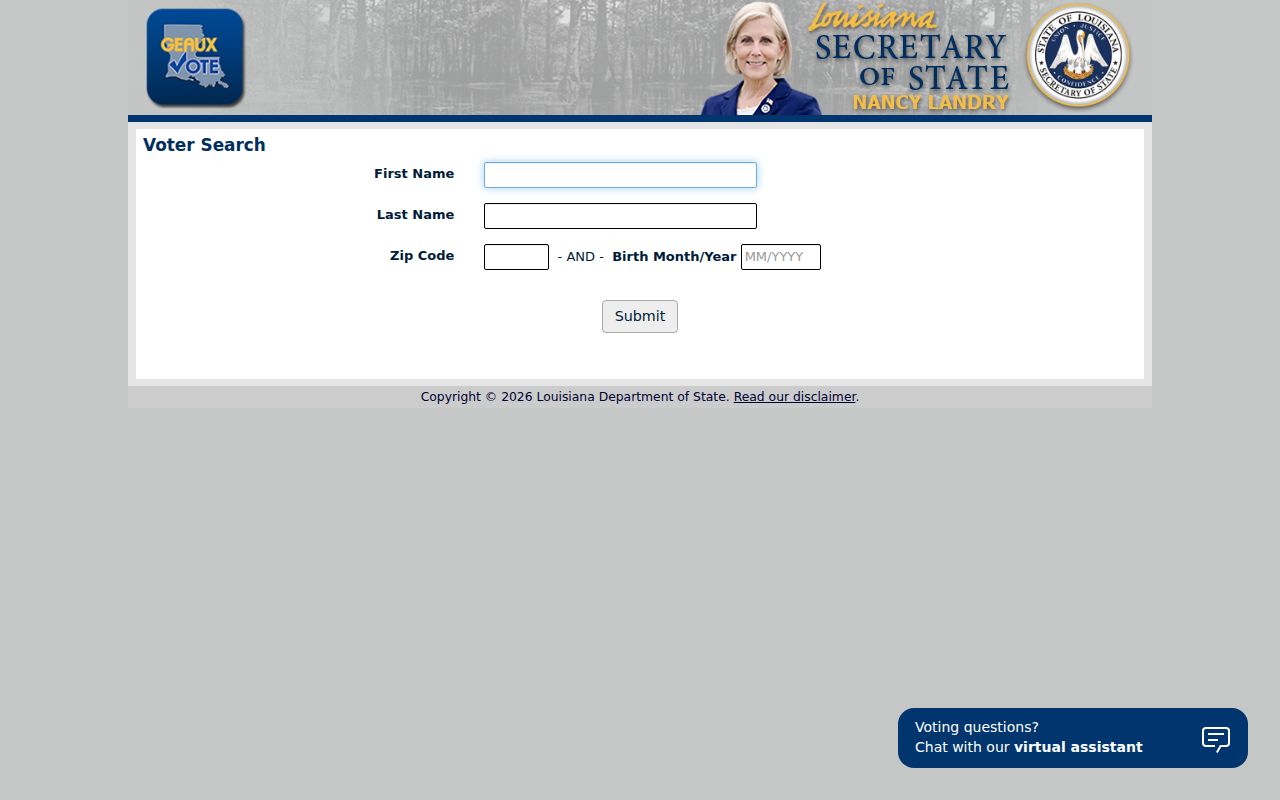
ZIP and birth month and year do the narrowing. Protected voter fields and confidential addresses must never be republished, a point the official portal itself makes clear.
Lawful use. Use Lafayette resident records for lawful personal research, and never use an address or identity clue to stalk, harass, or harm anyone.
Lafayette Court Lookup Paths
No single database holds Lafayette court records. The Fifteenth Judicial District Court handles parish-level matters. Lafayette City Court keeps its own civil, criminal, juvenile, and traffic jurisdiction. Federal files sit in the Western District of Louisiana through PACER. ClerkConnect is separate from land eSearch. Sealed, expunged, juvenile, and confidential matters simply will not appear like open docket entries. For a same-name result, preserve the court, case number, filing date, party role, and disposition, and remember that a docket is only the court's chronological case record, not proof two entries describe the same resident. A phone call or counter visit closes the gap.
Lafayette Records Request Route
The Louisiana Public Records Law, La. R.S. 44:1 et seq., opens an inspection and copy route when a municipal search page stops short. Lafayette Consolidated Government launched JustFOIA in March 2025. The system hands out a request ID. It also adds tracking and fee notice before fulfillment, and LCG publishes publicrecords@lafayettela.gov and 337-291-8015. The LCG public-records request page lays out the public route.
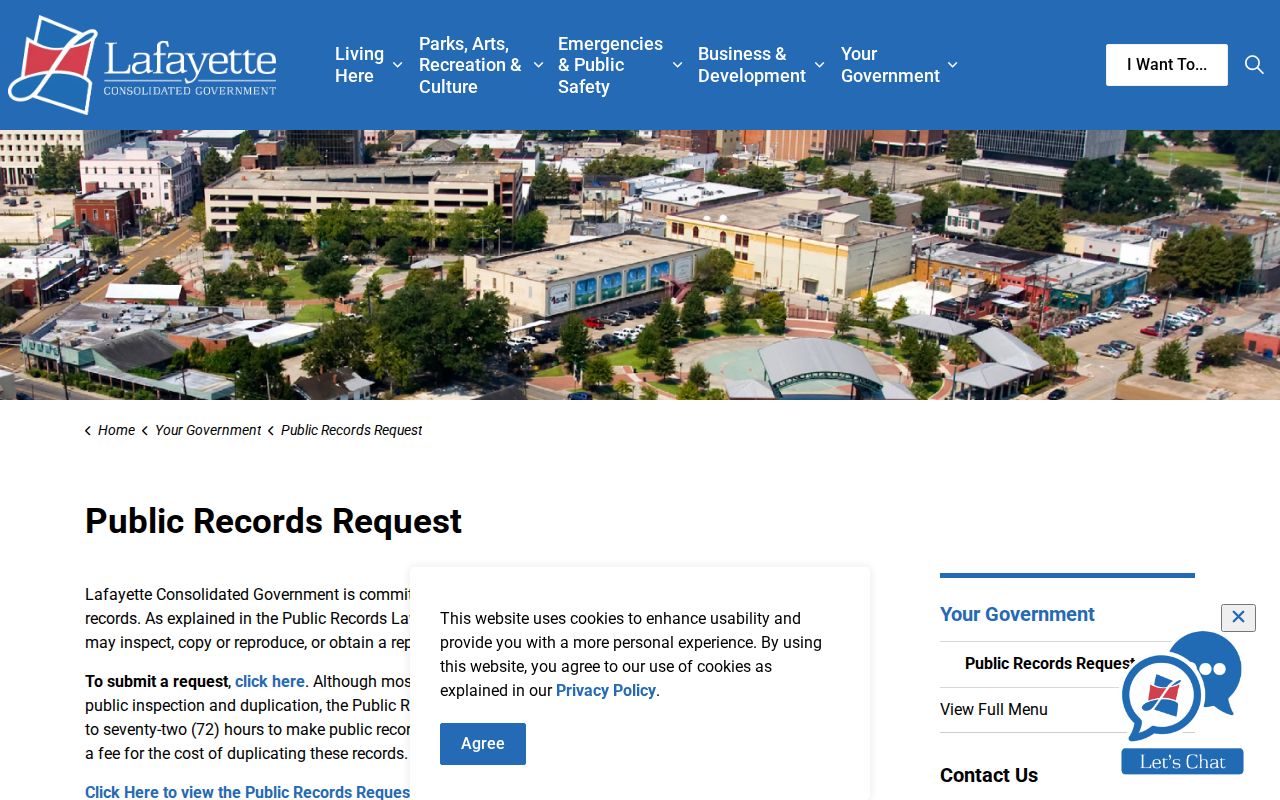
Name an exact address, parcel, department, and date range so the custodian need not guess. The linked JustFOIA request portal is the online submission point.

The portal is one channel among several for Lafayette Parish records. It does not replace the Clerk's own procedure for recorded deeds or court copies.
Lafayette Business Directory Checks
Not every Lafayette address belongs to a person. It may sit with an entity, an estate, a trust, a school, a church, or a public body. The Louisiana commercial search queries entity names, charter or trade numbers, officers, and agents. The record can settle the legal name you carry into the deed index. Remember that an agent's address never proves a residence.
The official business search screen displays those entry points.
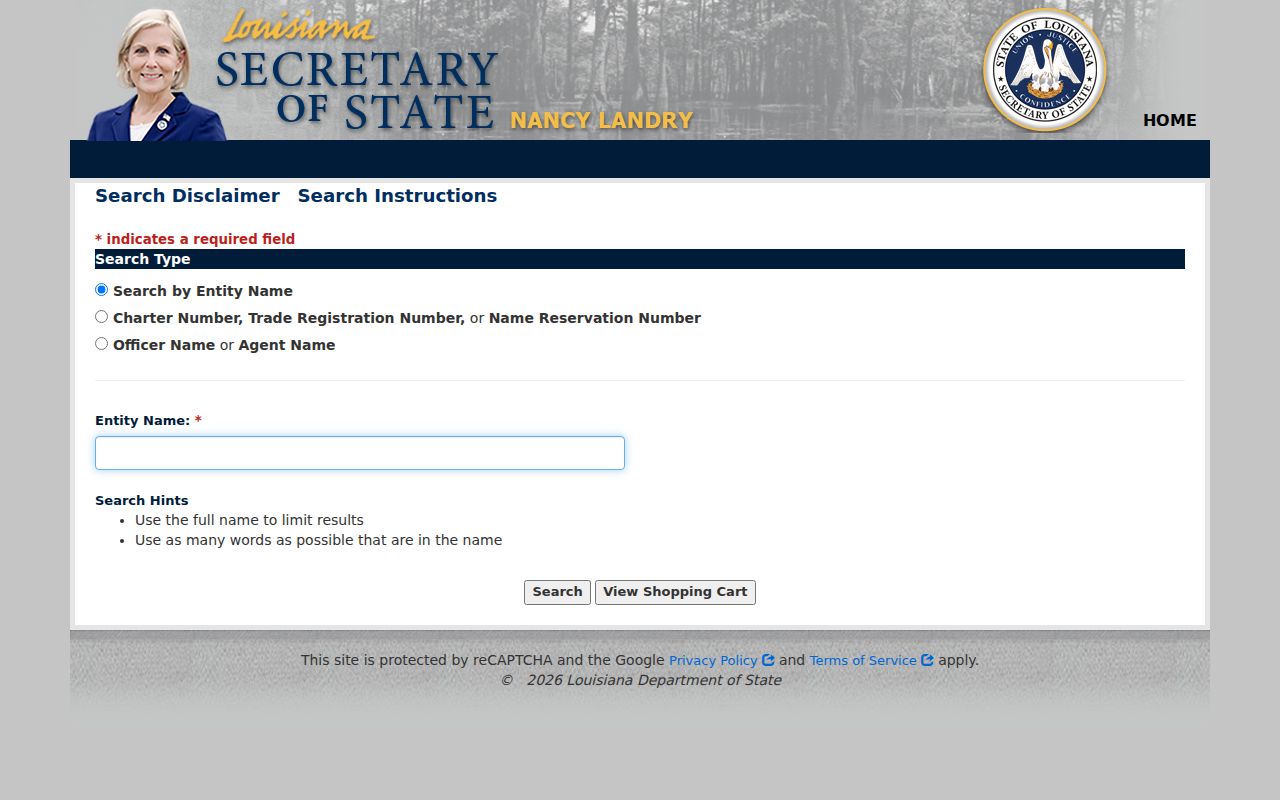
Search punctuation and abbreviated forms as separate queries. Then match the entity to a recorded document number or parcel before drawing any connection.
Lafayette Custody Records Directory
Custody data for Lafayette Parish lives in several separate systems. The Sheriff's 365Labs portal covers current Lafayette Parish Correctional Center occupants and recent bookings. State custody runs through the DPS&C and VINE routes instead. The Louisiana State Police registry is a third database. It serves a different legal purpose and scope.
The Sheriff moved from JADES to 365Labs. Old links and saved screens may no longer match the current search fields. Note the portal name and the search date with any result. For a state record, use the DPS&C or VINE route. Do not assume the parish booking system follows a person after transfer.
The Louisiana State Police registry information page spells out the official search conditions.
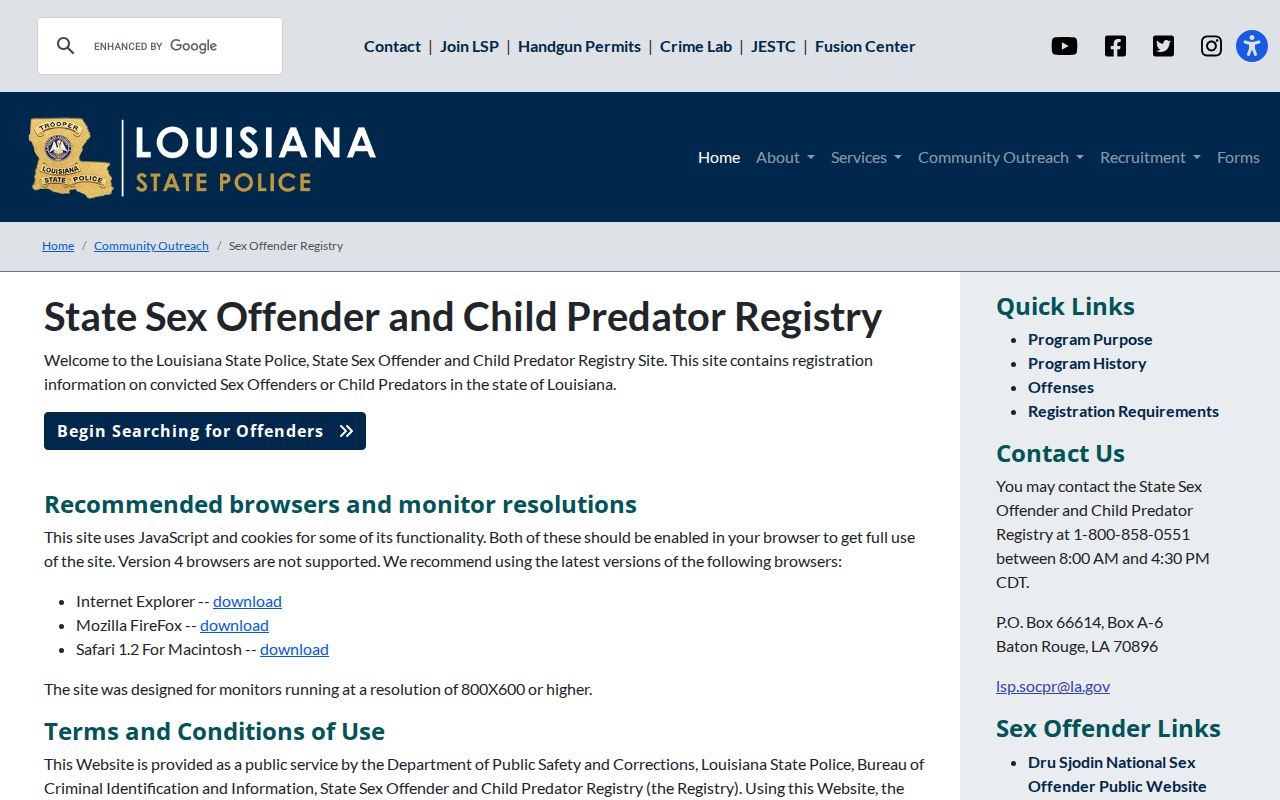
Keep the source and access date with every result. A booking entry is not a finding of guilt, and a missing portal match proves nothing beyond that search.
Historical Lafayette Residents Directories
Lafayette's historical resident trail is scattered across city directories, newspapers, maps, and archival collections. Verified microfilm holdings cover 1939, 1941, 1946, 1949, 1952, 1955, and 1957 through 1959. Local material points to many more directory years from 1946 forward. No complete year-by-year run checks out, though. The Daily Advertiser obituary index spans 1882 through 2022. Lafayette Gazette holdings begin in 1893.
A directory line is a dated snapshot. Record the printed spelling, address, occupation label, spouse, page, and year. Then compare the entry against the Lafayette city directory collections. A deed, a newspaper issue, or a census record can confirm it further. The 1903 and 1912 Sanborn maps can settle older block and street clues. Maps, though, are not resident rolls.
Lafayette Resident Privacy Limits
Some lawful records in Louisiana stay closed or partly hidden. Birth certificates are restricted for 100 years after the birth year. Death certificates are restricted for 50 years after the death year. Only eligible applicants may request them through the Vital Records process. The state's Address Confidentiality Program also gives qualifying victims of abuse, sexual assault, or stalking a substitute address. Their true location never enters a public roll.
The voter portal does not expose protected registration fields, and motor-vehicle data sits behind its own restrictions. So a name missing from one Lafayette directory can mean several things. The person may hold a protected address. The person may fall outside that roll's coverage, or may use a different legal spelling. None of those outcomes justifies guessing at where someone lives. The residents directory exists to help with lawful lookup, not to defeat a privacy shield.
Dates matter when you weigh any record. Assessor ownership shifts after a sale. Court dockets gain later entries, and voter records get updated. A printed directory stays frozen at its publication year. Beside every useful name, save the custodian, the search mode, the access date, and the exact role. If your result came from an index, pull the image or ask the office. Do that before trusting the summary as the whole record.
Closed certificates have their own custody rules. Louisiana vital applications require the record subject, event details, relationship, identification, and a signature. Marriage and divorce records follow the Clerk of the parish where the event occurred or was granted. Older qualifying birth and death material can transfer to the Louisiana State Archives. A resident lookup must respect those lines. Knowing a name is not permission to inspect a closed certificate.
Guard against fraud in any Lafayette search. A message demanding an urgent fee to remove a public record is a red flag. So is a claim of access to a secret government roster or a copied court heading. Check with the named custodian through its official contact. Keep your receipts and messages, and use the Louisiana Attorney General consumer route if a scam seems likely.
Older family trails follow a different custody path. The State Library holds Louisiana directories, maps, newspapers, parish microfilm, and FamilySearch affiliate resources. State Archives catalog and microfilm routes may require Clerk permission for parish material. UL Lafayette Special Collections asks researchers to work from finding aids and collection identifiers. Record the box, series, fiche, page, or issue so another person can retrace the result. That discipline also protects against a vague surname match.
Lafayette Parish was created from St. Martin Parish in 1823. That boundary fact matters. An earlier family or land entry may therefore appear under a neighboring parish. The Clerk's marriage table begins June 30, 1823, but each record series has its own start date. One early date never proves that all courthouse material is complete from that year.
Never infer a present home from an old city directory, mailing address, entity filing, or newspaper notice. Confirm with the custodian instead. Keep sensitive facts private. Report any immediate threat to the right law-enforcement office. Personal curiosity and family research still call for restraint.
Note: Louisiana Act 502 is enacted but does not take effect until January 1, 2027. It is not a current deletion route.